
Divorce Made Easier.
A simpler, faster way to get divorced in New York.
When you and your spouse agree, getting divorced shouldn’t be complicated.
Express Divorce makes the uncontested divorce process easier — with straightforward steps, clear pricing, and the experience of a New York matrimonial law firm behind you.
See if you qualify in just a few minutes.
The Ultimate Guide to Getting Started With Divorce in New York
Starting a divorce can feel overwhelming, especially when you are trying to make legal, financial, and family decisions at the same time. The process becomes more manageable when you break it into practical steps and understand what New York requires before you begin.Whether you are only starting to consider divorce or you and your spouse are already discussing an uncontested resolution, the following steps can help you prepare more deliberately and avoid unnecessary complications.

1. Decide How — and Whether — to Involve Your Spouse
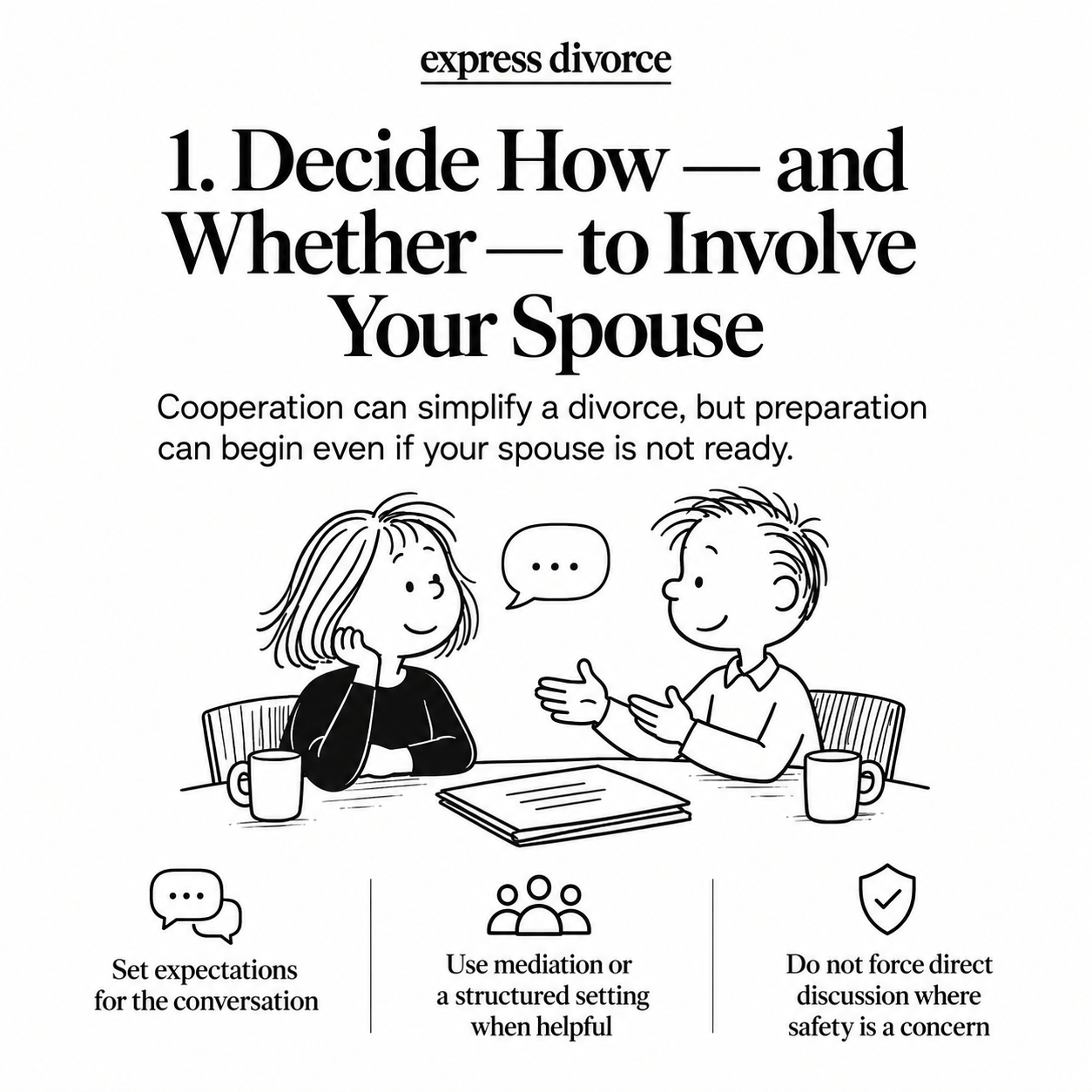
If communication is appropriate and safe, an early conversation can help determine whether you and your spouse are capable of resolving the divorce cooperatively.
You do not need to settle everything in one discussion. The immediate goal may simply be to understand whether you are generally aligned about moving forward and which issues still need to be addressed.
Useful topics can include:
whether both spouses are prepared to divorce;
whether you expect the divorce to be uncontested;
how you will exchange financial information;
whether either spouse intends to remain in the marital home;
how immediate household expenses will be handled; and
how you will discuss changes with your children, if applicable.
For some couples, mediation or another structured setting can make these conversations more productive.
If your spouse is unwilling to participate, however, that does not prevent you from learning your rights, organizing your records, or consulting an attorney. And where there are concerns involving domestic violence, coercive control, intimidation, or safety, a direct conversation may not be appropriate at all.
Key takeaway: Cooperation can simplify a divorce, but you can still prepare even when your spouse is not ready to engage.
2. Confirm That You Can File for Divorce in New York
Before preparing documents, determine whether New York is the proper state in which to start the divorce.
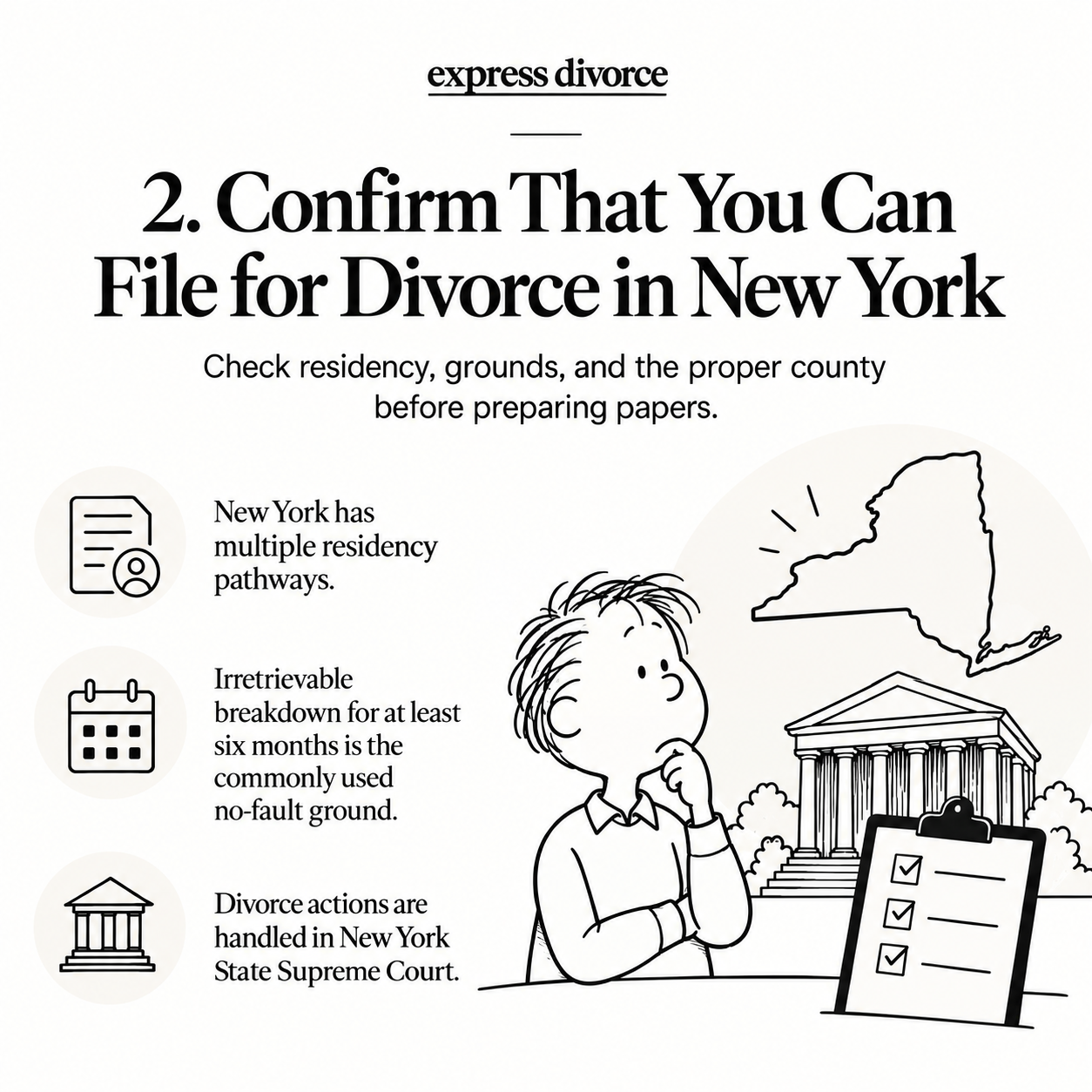
New York has several statutory residency pathways. Depending on the circumstances, jurisdiction may be based on one or two years of continuous New York residence, where the parties married, where they lived together as spouses, or where the grounds for divorce occurred.
New York also requires a legally recognized ground for divorce. The most commonly used ground is an irretrievable breakdown of the marriage for at least six months, stated under oath by one spouse.
Unlike some states, New York does not have one universal 30-, 60-, or 90-day waiting period that applies to every divorce after filing. Court procedure and processing time vary depending on the case and county.
Divorce actions are handled in the New York State Supreme Court.
Key takeaway: Before preparing the papers, confirm New York residency, grounds, and the proper county for filing.
3. Gather the Documents You Will Need
One of the most useful things you can do early is organize your records.
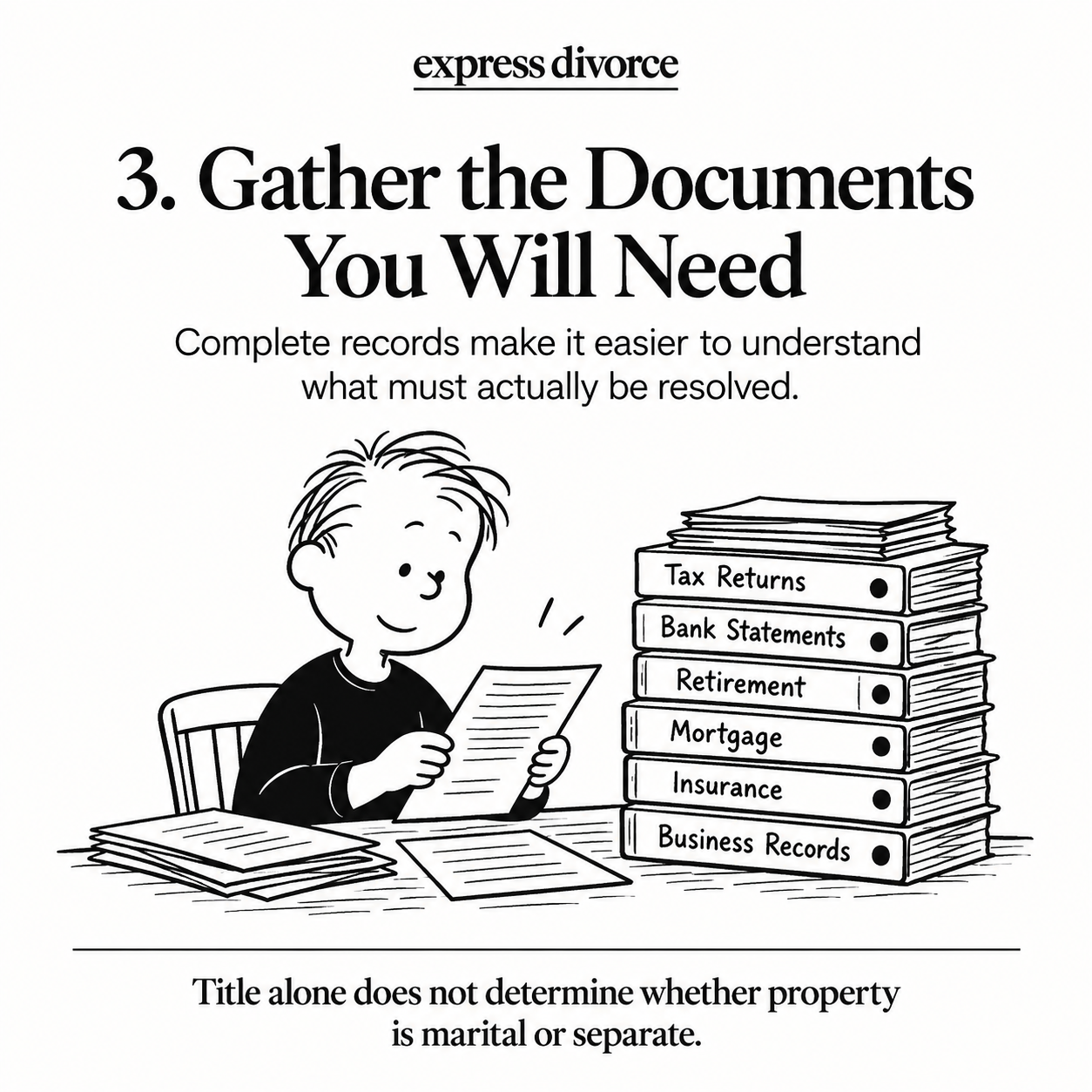
The exact documents needed will depend on your marriage, but consider gathering:
marriage certificate;
prenuptial or postnuptial agreement, if any;
recent federal and state tax returns;
pay statements and other income records;
checking and savings account statements;
brokerage and investment statements;
retirement and pension statements;
mortgage and home-equity loan statements;
deeds and other real-estate records;
credit-card and loan statements;
insurance policies;
business records, if either spouse owns an interest in a business; and
documents showing when significant assets were acquired.
Do not assume that an asset belongs to one spouse simply because it is titled in that spouse’s name. Under New York law, marital property generally includes property acquired by either spouse during the marriage and before the applicable statutory cutoff, regardless of title, subject to the separate-property rules.
Similarly, property acquired before marriage, certain inheritances and third-party gifts, and other categories of property may constitute separate property.
Key takeaway: The more complete your financial records are, the easier it is to understand what must actually be resolved.
4. Understand Your Financial Picture
Before negotiating a settlement, know what the marriage owns, what it owes, and what each household may need after divorce.
Start by identifying:
each spouse’s income;
marital and potentially separate assets;
mortgages and other secured debt;
credit cards and personal loans;
retirement accounts;
recurring household expenses;
insurance obligations; and
expected post-divorce expenses.
New York is an equitable distribution state. Marital property is divided equitably based on the circumstances; equitable does not necessarily mean an automatic 50/50 division. Separate property generally remains separate.
A proposed settlement should also be tested against real life. If one spouse plans to keep the home, for example, consider not only the equity but also the mortgage, refinancing requirements, taxes, insurance, repairs, and ongoing affordability.
Creating a realistic post-divorce budget can help you evaluate whether an agreement is sustainable.
Key takeaway: A settlement should make financial sense after the divorce, not merely balance on paper.
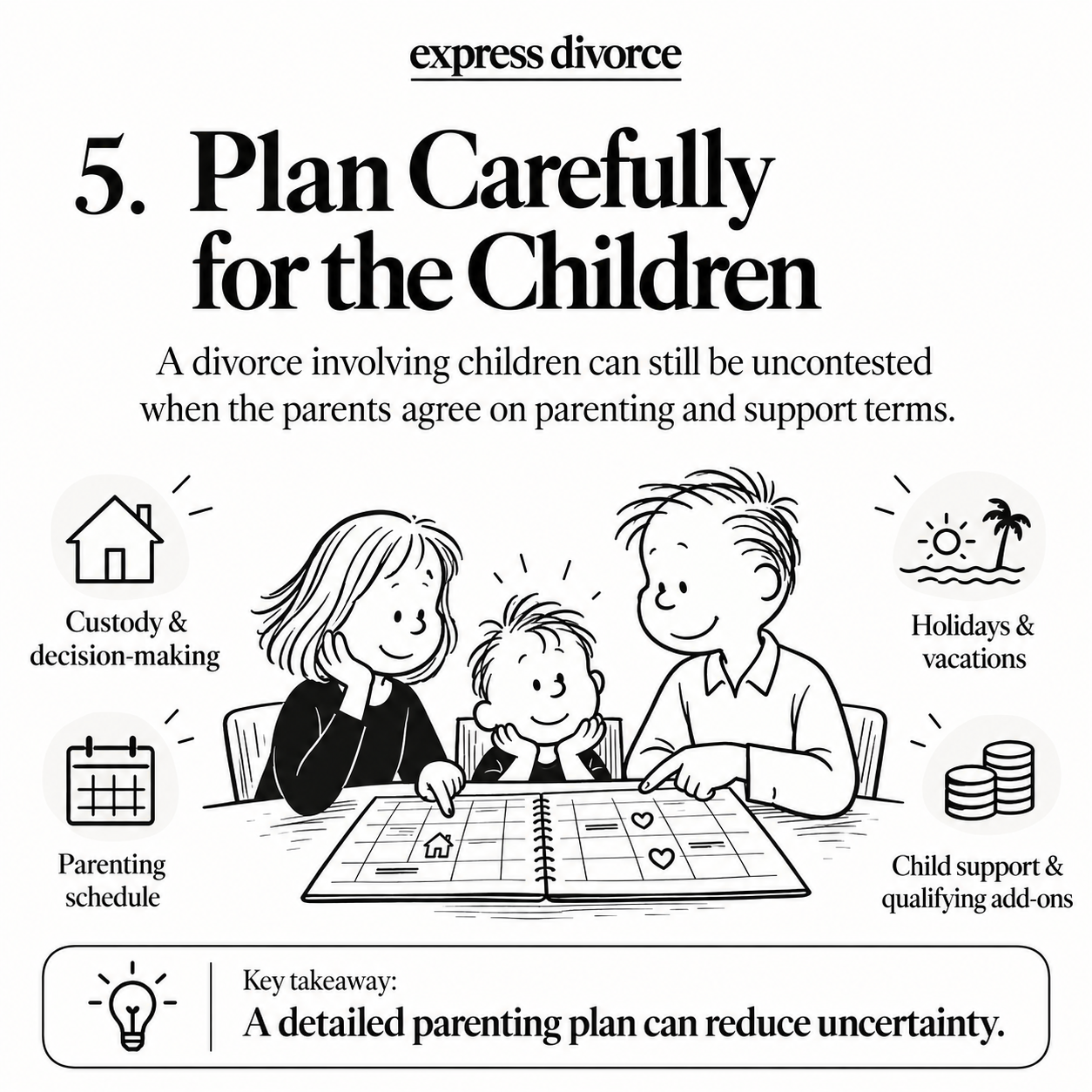
5. Plan Carefully for the Children
A divorce involving children can still be uncontested when the parents agree on the parenting and support issues that need to be resolved.
A comprehensive parenting discussion may address:
legal custody and major decision-making;
the regular parenting schedule;
school-week and weekend arrangements;
holidays and school vacations;
summer schedules;
transportation and exchanges;
communication between the parents;
telephone or video contact with the other parent;
travel;
medical and educational decisions; and
child support and qualifying child-related expenses.
If the parents cannot agree and the court must decide custody or parenting time, New York courts focus on the best interests of the child. There is no single automatic custody formula; courts consider the circumstances affecting the child’s welfare, safety, stability, and relationship with each parent.
Child support is governed by New York’s Child Support Standards Act and generally involves the parents’ income, the number of children, the statutory basic-support calculation, and applicable add-on expenses.
Key takeaway: A detailed parenting plan can reduce uncertainty and make an uncontested divorce with children much easier to complete.
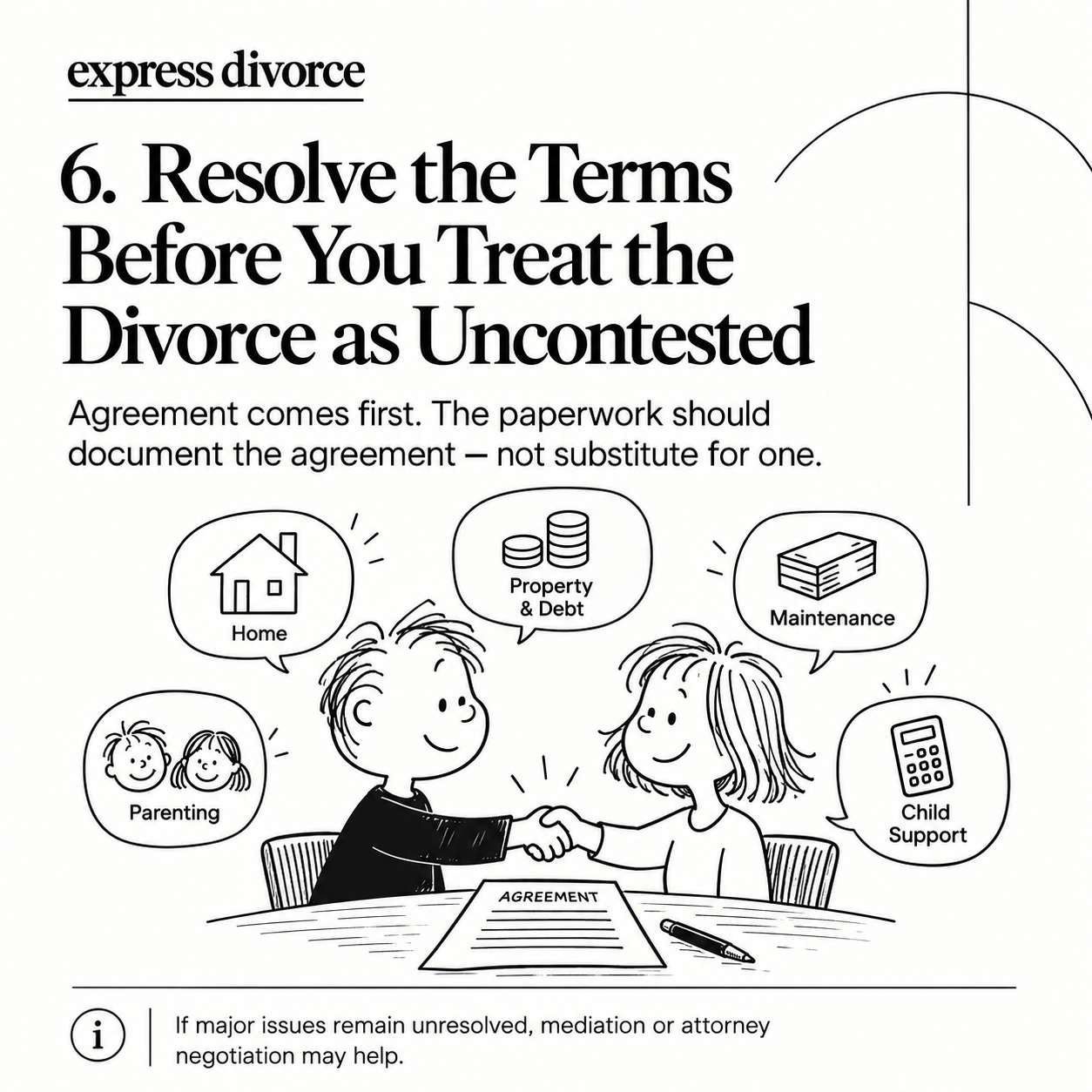
6. Resolve the Terms Before You Treat the Divorce as Uncontested
An uncontested divorce is not simply a divorce in which both spouses agree that the marriage should end.
New York Courts describes an uncontested divorce as one in which the spouse agrees with all parts of the divorce.
For a no-fault divorce, the economic and parenting issues that apply to the marriage must ultimately be resolved by agreement or determined by the court before judgment can be entered. Those issues can include equitable distribution, maintenance, child support, fees, custody, and parenting time.
Before preparing a final agreement, identify what remains unresolved.
For example:
Who keeps or sells the home?
How will bank and investment accounts be divided?
What happens to retirement accounts?
Who assumes particular debts?
Will either spouse pay maintenance?
What are the parenting arrangements?
How will child support and add-on expenses be handled?
If the parties do not yet agree, mediation or attorney negotiation may help them work toward an uncontested resolution.
Key takeaway: Agreement comes first. The paperwork should accurately document the agreement—not substitute for one.
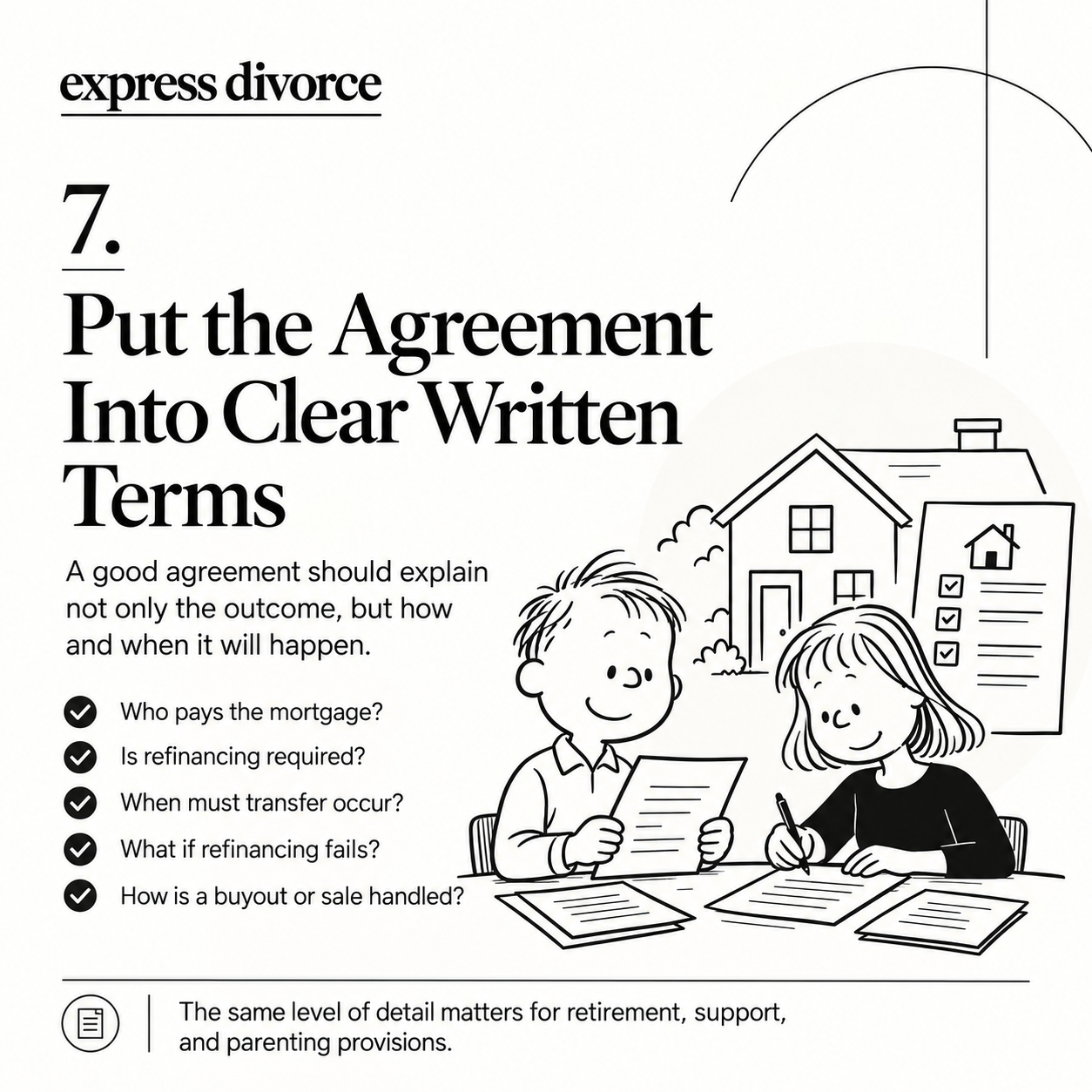
7. Put the Agreement Into Clear Written Terms
Once the parties agree, the settlement should be documented carefully.
A divorce agreement may address significant rights involving property, support, retirement benefits, real estate, debt, and children. Ambiguous language can create problems long after the divorce is finished.
For example, saying that one spouse will “keep the house” may not answer:
who is responsible for the mortgage;
whether refinancing is required;
when refinancing must occur;
what happens if refinancing is unsuccessful;
who pays carrying costs before transfer;
whether one spouse receives a buyout; or
how a later sale would be handled.
The same attention is necessary for retirement accounts, support provisions, parenting schedules, and other obligations.
New York Courts specifically cautions that failing to address rights such as a spouse’s pension during the divorce can result in those rights being lost.
Key takeaway: A good settlement agreement should describe not only the outcome, but also how and when that outcome will be carried out.
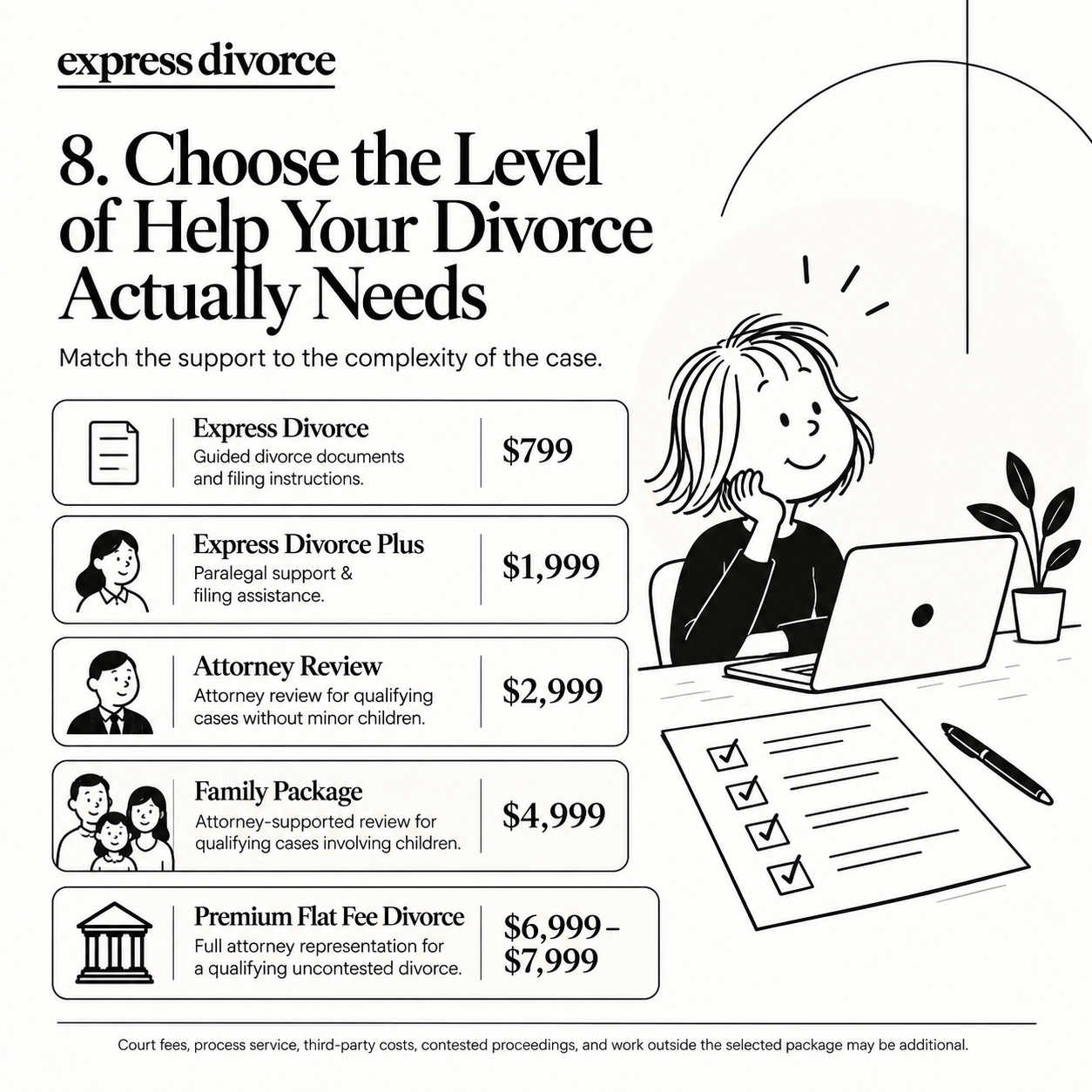
8. Choose the Level of Help Your Divorce Actually Needs
Not every uncontested divorce requires full attorney representation, but not every divorce should be handled as a paperwork-only matter either.
The appropriate level of assistance depends on the complexity of the marriage and how much has already been resolved.
With Express Divorce, qualifying New York uncontested matters can choose from different levels of support:
Express Divorce — $799
Guided divorce documents and filing instructions.
Express Divorce Plus — $1,999
Document preparation, dedicated paralegal support, filing assistance, signature coordination, and case tracking.
Attorney Review — $2,999
Attorney review for qualifying uncontested cases without minor children.
Family Package — $4,999
Attorney-supported review for qualifying uncontested cases involving children.
Premium Flat Fee Divorce — $6,999–$7,999
Full attorney representation for a qualifying uncontested divorce.
Court filing fees, process service, third-party costs, contested proceedings, and work outside the selected package may be additional.
Key takeaway: Use the level of professional support that matches the actual complexity of your divorce.
Final Thoughts
Getting started with divorce does not have to mean solving everything at once.
Begin by determining whether New York is the correct jurisdiction. Gather the documents that show the financial picture. Understand the assets and debts. Create a realistic budget. If children are involved, begin working through parenting and support arrangements. Then identify which issues have already been resolved and which still require negotiation.
For couples who reach agreement, the New York uncontested divorce process can offer a more straightforward path through Supreme Court. When important issues remain unresolved, address those issues before treating the matter as an uncontested filing.
Ready to Get Started?
Answer a few questions about your marriage, the issues you have already resolved, and the level of support you want.
Express Divorce can help you identify the path that may fit your New York uncontested divorce.
Get Started