
Divorce Made Easier.
A simpler, faster way to get divorced in New York.
When you and your spouse agree, getting divorced shouldn’t be complicated.
Express Divorce makes the uncontested divorce process easier — with straightforward steps, clear pricing, and the experience of a New York matrimonial law firm behind you.
See if you qualify in just a few minutes.
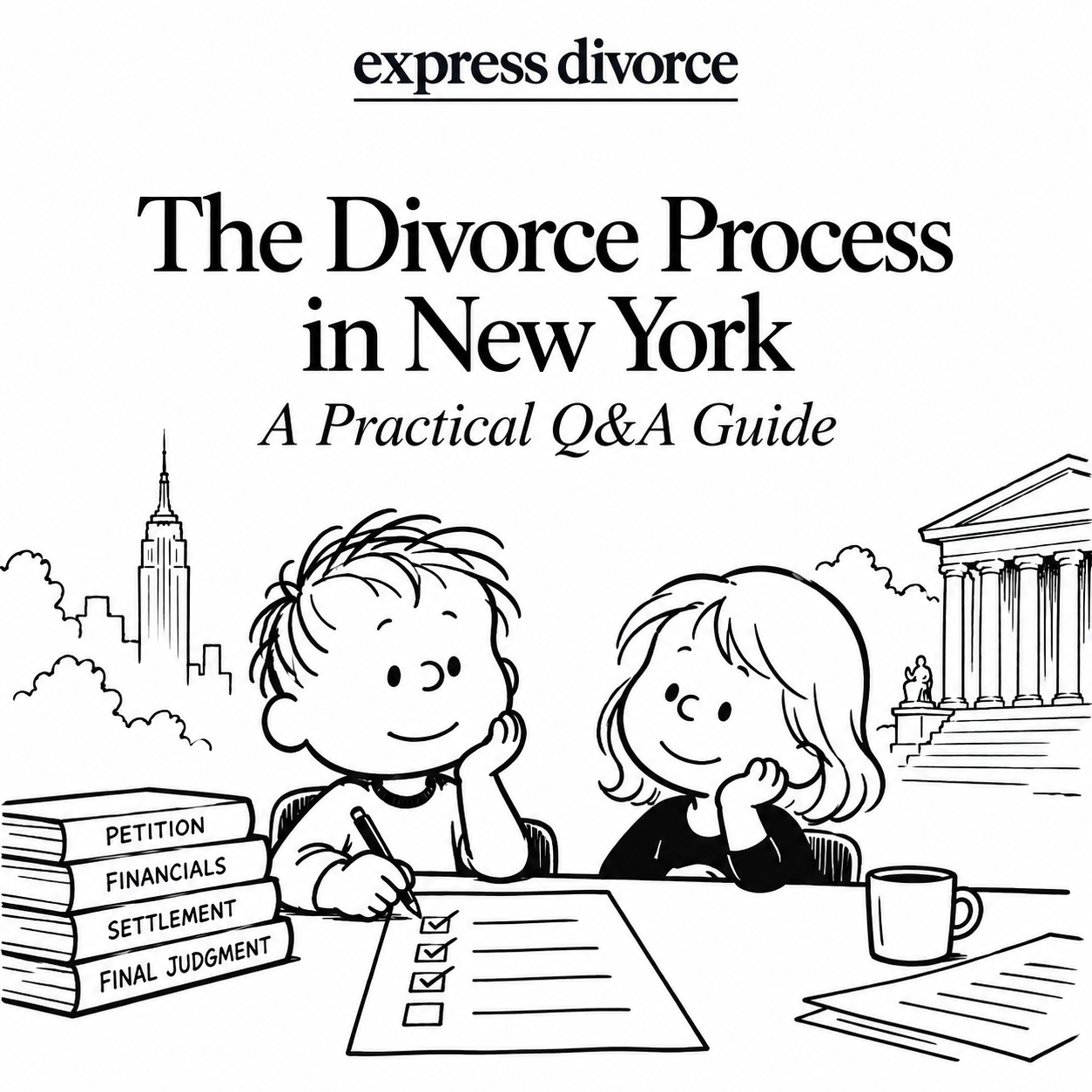
The Divorce Process in New York: A Practical Q&A Guide
Divorce can feel overwhelming because legal procedure, financial decisions, parenting issues, and paperwork all have to come together before the case can be finalized.
The source Q&A focused on a few core ideas: understanding whether a divorce is contested or uncontested, preparing the necessary information, resolving disagreements, deciding when professional help may be useful, and completing the filing process.
For New York couples, those same questions can be answered more precisely by looking at how the New York Supreme Court handles divorce.
Contested vs. Uncontested Divorce in New York
The first question is whether you and your spouse agree on the issues that must be resolved.
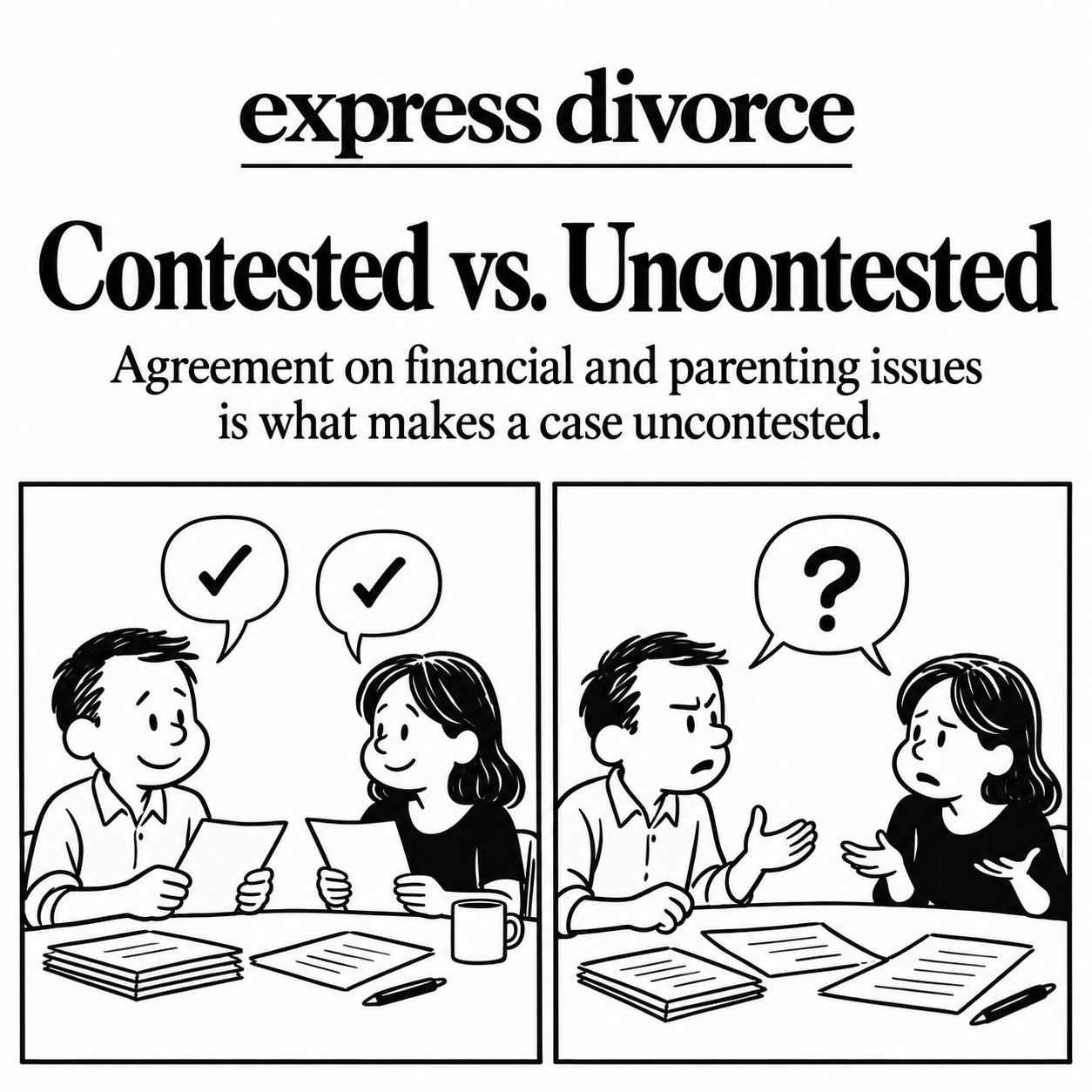
A New York divorce is generally uncontested when both spouses agree to the divorce and have resolved the financial and parenting issues that apply to their case. Those issues can include property, debt, maintenance, custody, parenting time, and child support.
A divorce becomes contested when the spouses disagree about the divorce itself or about one or more of those issues. Contested cases may require motions, discovery, negotiations, conferences, hearings, or trial before the court can resolve the disputes.
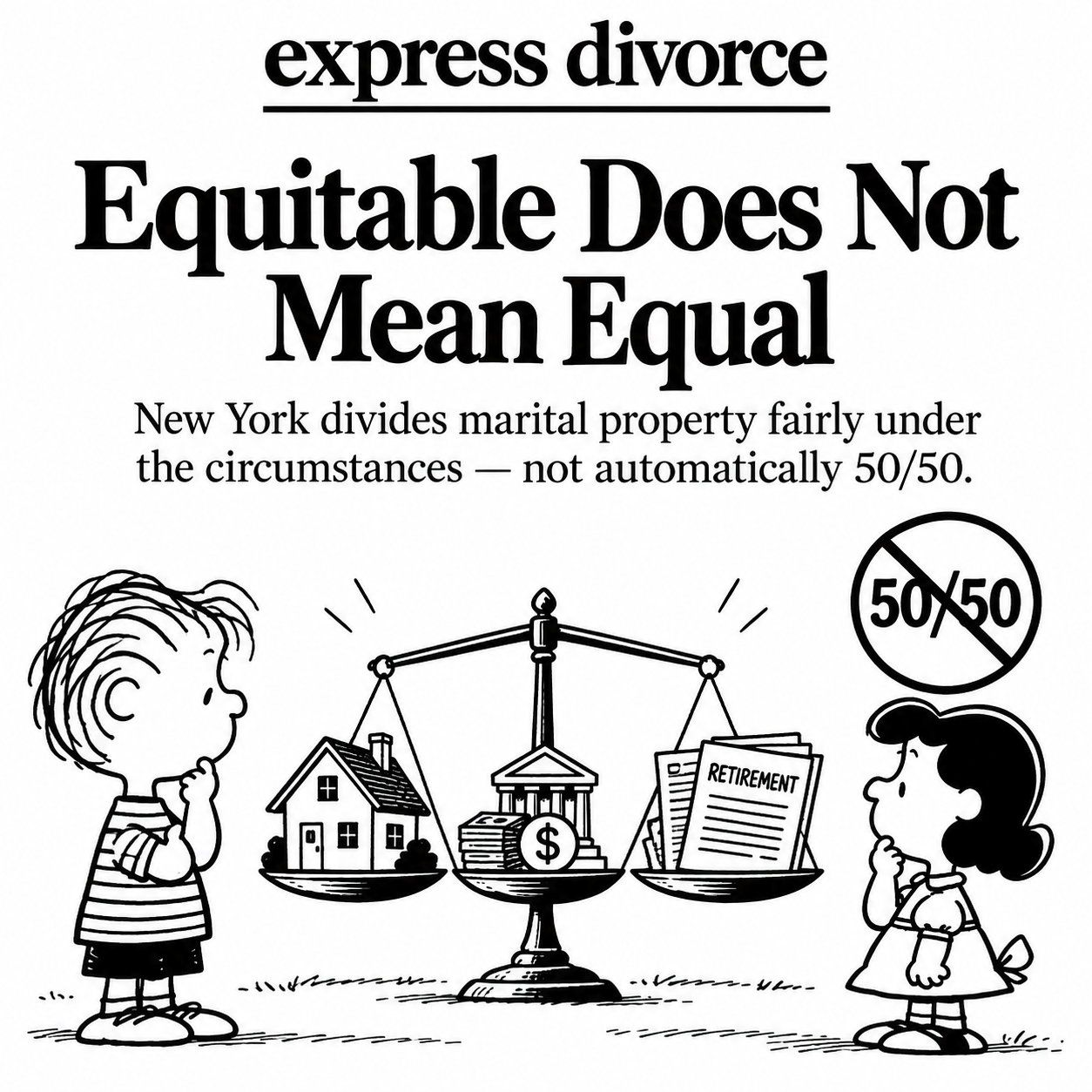
Does Uncontested Mean Everything Is Split 50/50?
No.
New York is an equitable distribution state. Marital property is divided equitably, which means fairly under the circumstances—not automatically equally. The original Q&A correctly emphasized that reaching agreement does not require dividing every asset down the middle.
If you and your spouse agree on a division that works for both of you, that agreement can form the basis of an uncontested divorce, subject to applicable law and court review.
How Long Does an Uncontested Divorce Take in New York?
There is no single statewide completion time.
The source material gave national estimates for cooperative and contested divorces, but those numbers should not be carried over to a New York-specific article because timing varies substantially by county, court workload, service, completeness of the documents, and whether corrections are required.
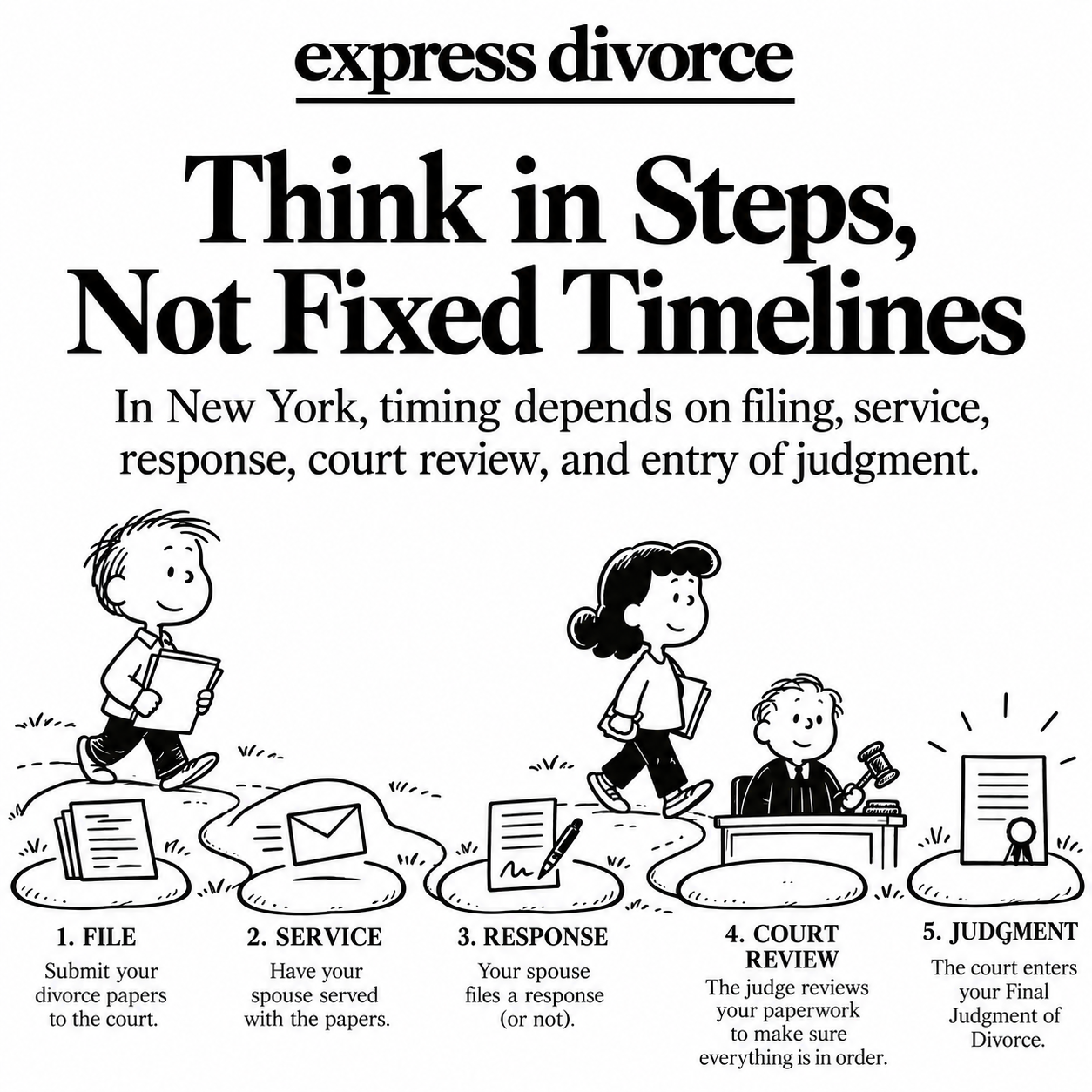
In New York, the process includes commencement of the case, service where required, the defendant’s response or default, filing the remaining uncontested papers, judicial review, and entry of the Judgment of Divorce.
There is also no universal 30-, 60-, or 90-day waiting period applicable to every New York divorce.
Key takeaway: It is more accurate to think in terms of the procedural steps than to rely on a fixed statewide timeline.
What Should You Prepare Before Starting?
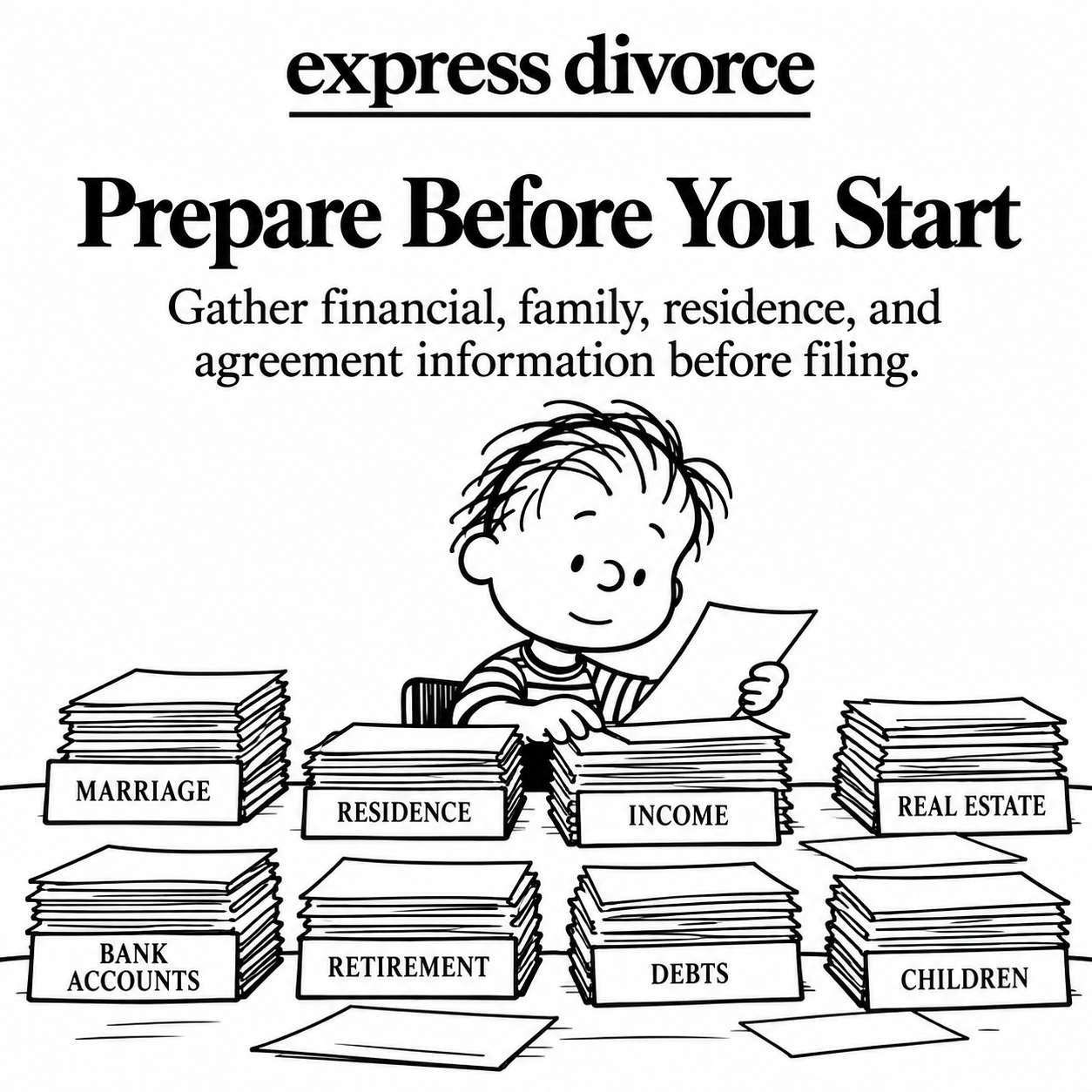
One of the most useful parts of the original Q&A was its emphasis on gathering information before completing the forms.
Before starting a New York uncontested divorce, gather information relating to:
you and your spouse;
your marriage and residence history;
income and employment;
real estate;
bank and investment accounts;
retirement accounts;
debts;
maintenance, if applicable;
children, custody, parenting time, and support; and
any agreements you have already reached.
You should also determine whether New York’s residency and grounds requirements are satisfied before filing.
Can One Spouse Complete the Divorce Without the Other Participating?
This requires an important distinction.
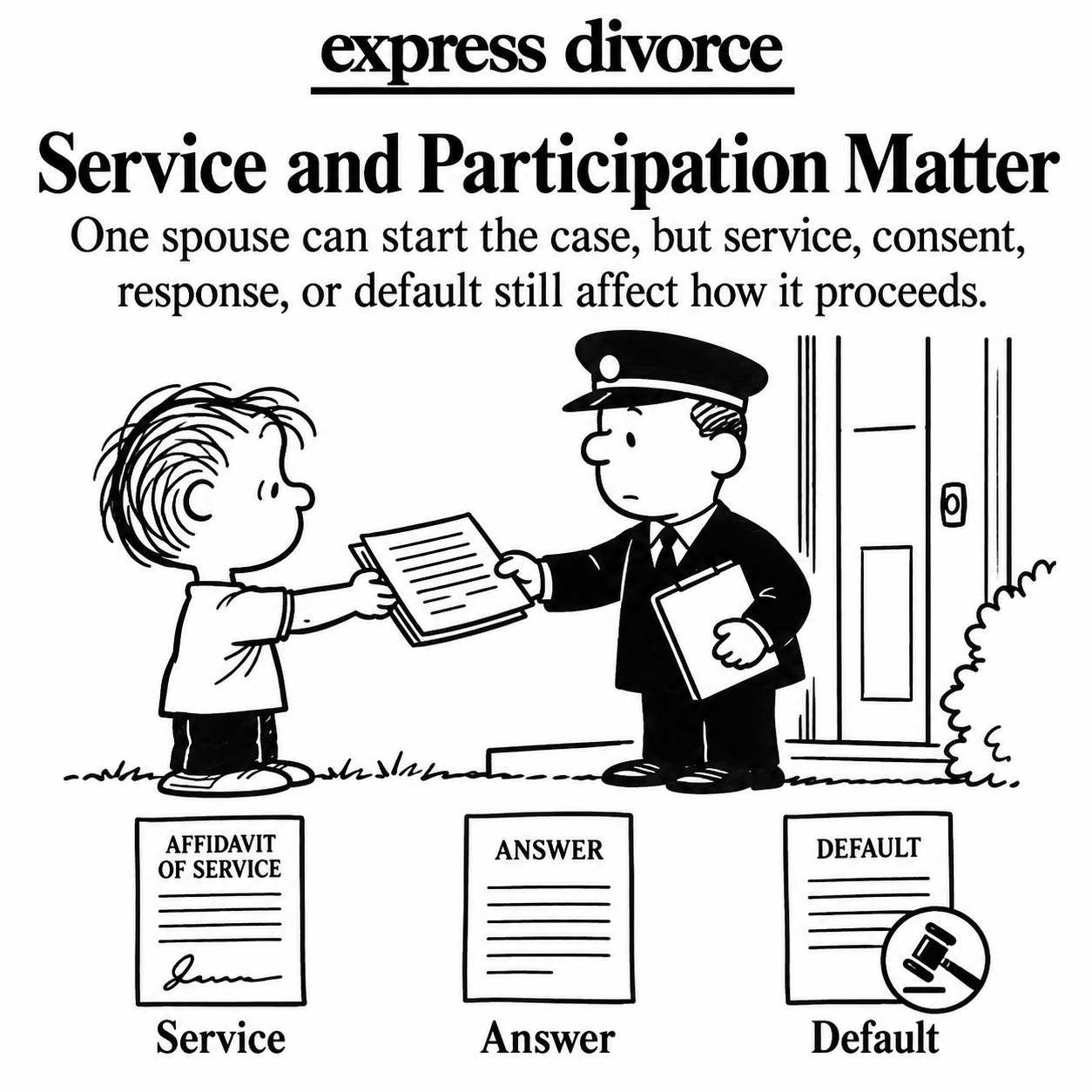
One spouse can begin a divorce action even if the other spouse is not actively helping complete paperwork. However, whether the case can proceed as uncontested depends on the circumstances.
In a standard New York divorce, the defendant generally must be served with the commencement papers. The plaintiff cannot personally serve the defendant, and service generally must occur within 120 days after filing unless another method is authorized.
The defendant may:
sign an Affidavit of Defendant and agree to the divorce;
answer and contest the case; or
fail to respond and default.
If you cannot locate your spouse, alternative service may be possible, but court authorization may be required.
The original source discussed collaborative platform participation by both spouses, including shared visibility and questionnaire completion. For Express Divorce, I would not promise that both parties can log into the same workflow unless your current product actually supports that feature.
What Happens If We Agree on Most Things but Not Everything?
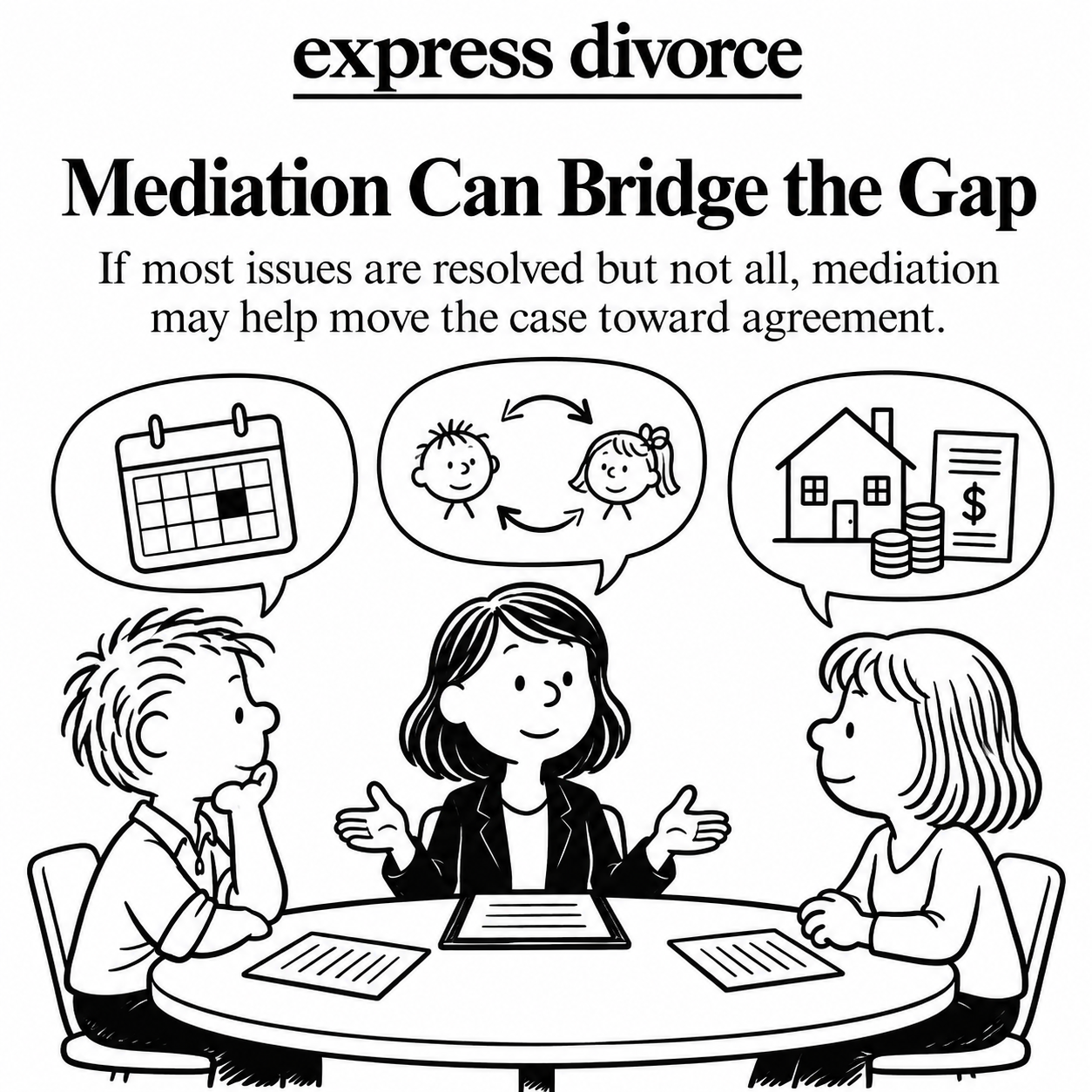
That is where mediation can be useful.
The original Q&A described mediation as a process in which a neutral person helps spouses discuss unresolved issues and work toward mutually acceptable terms. Common subjects included parenting schedules, property, debt, spousal support, and child support.
New York Courts likewise identifies mediation and collaborative family law as possible forms of Alternative Dispute Resolution when spouses believe they may be able to reach agreement with assistance.
A mediator does not represent either spouse and does not decide the case. The role is to facilitate discussion and help the parties explore possible solutions.
What Should You Do Before Mediation?
Preparation matters.
Think about:
what issues remain unresolved;
what information you need;
which outcomes are most important to you;
where you may be willing to compromise; and
which issues may require independent legal advice.
The source specifically emphasized identifying what is essential and where compromise may be possible before entering mediation.
When Might You Want an Attorney?
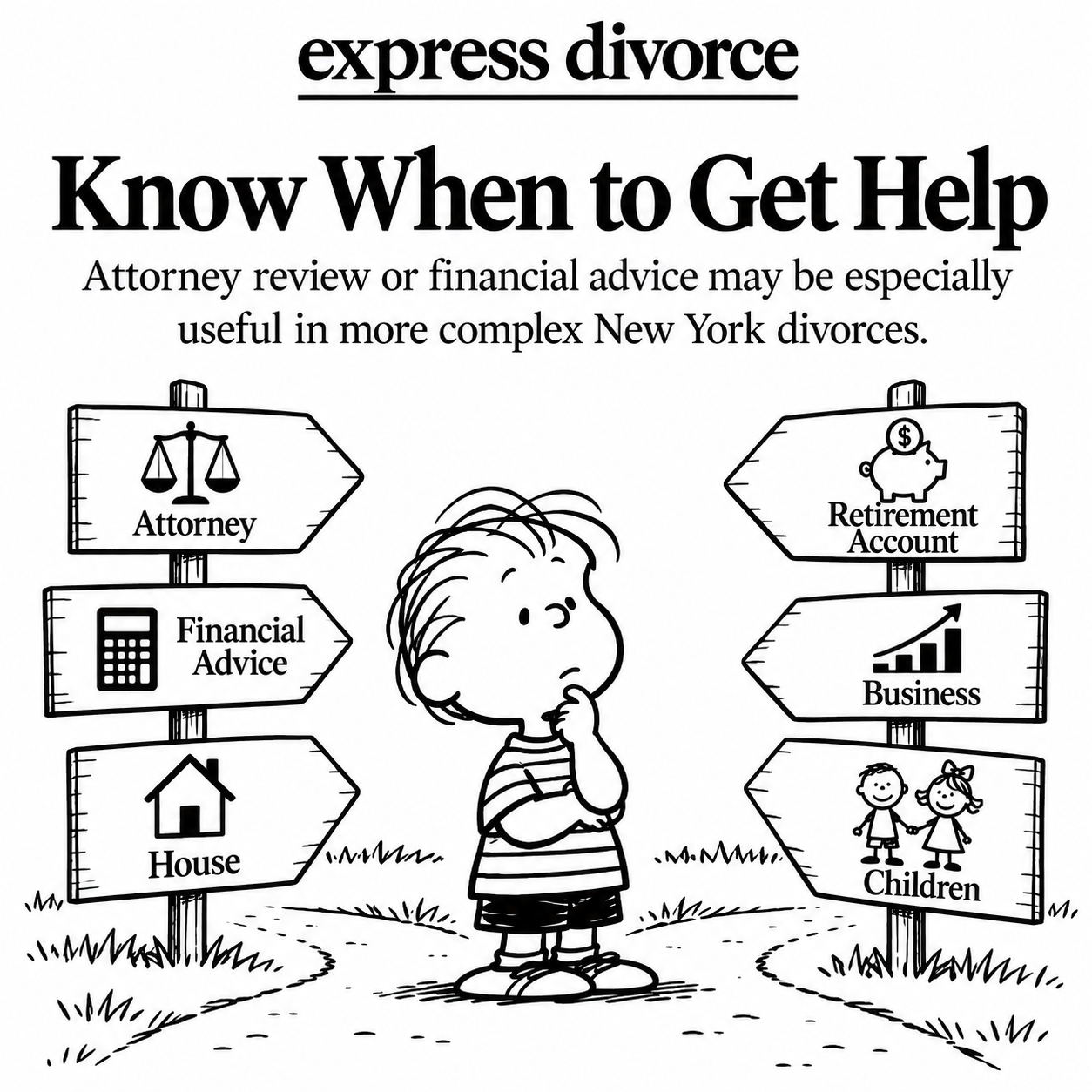
An uncontested divorce does not necessarily require full attorney representation, but there are situations where legal review may be particularly valuable.
Consider attorney involvement when the case includes:
significant real estate;
retirement assets;
businesses;
substantial separate-property claims;
complicated maintenance questions;
parenting disputes;
international issues;
unclear jurisdiction;
difficulty locating or serving a spouse; or
uncertainty about the legal effect of an agreement.
The original Q&A also recognized that some users may primarily want an attorney consultation or review of documents rather than full litigation representation.
That concept fits well with the Express Divorce model because different cases require different levels of support.
When Might Financial Advice Be Helpful?
Some divorce questions are legal. Others are financial.
The source suggested that a financial professional may be useful for questions involving support, debt, budgeting, assets, liabilities, retirement, insurance, taxes, and longer-term planning.
That can be particularly useful when evaluating:
whether one spouse can afford to keep the home;
the financial consequences of different property divisions;
retirement-account division;
debt allocation;
cash-flow after divorce; and
tax or investment consequences.
A financial adviser is not a substitute for legal advice, but can complement it.
Do You Need an Attorney to File a New York Divorce?
Not necessarily.
New York Courts provides uncontested-divorce forms and, for qualifying cases without children under 21, a DIY Uncontested Divorce Program.
That does not mean every uncontested divorce is simple enough to handle without professional help.
The more important question is whether you understand the legal rights being affected and whether the documents accurately reflect the agreement.
How Does an Uncontested Divorce Start in New York?
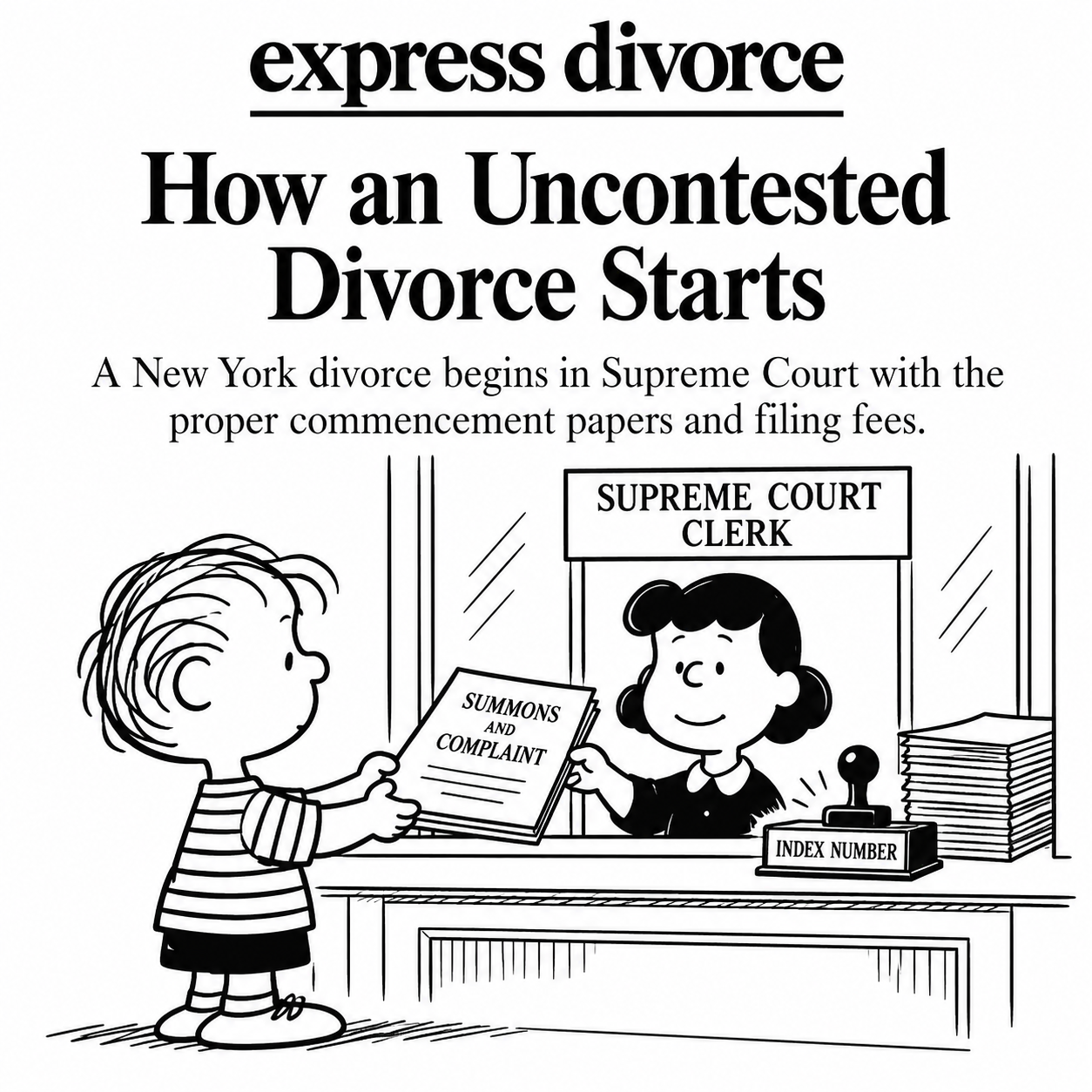
A New York divorce is commenced in Supreme Court by filing either a Summons With Notice or a Summons and Complaint with the County Clerk. The person filing is the Plaintiff and the other spouse is the Defendant.
The initial index-number filing fee is currently $210. Additional standard uncontested filing fees are generally required later in the process.
Depending on the county, electronic filing through NYSCEF may also be available.
What Happens After Filing?
In a standard uncontested case, the next major steps generally include:
Filing the commencement papers.
Serving the defendant where required.
Receiving the defendant’s response, signed consent, or default.
Preparing and filing the remaining uncontested-divorce papers.
Submitting the case for judicial review.
Obtaining the signed Judgment of Divorce.
Filing and serving the judgment as required.
If the defendant defaults, New York Courts instructs parties to wait 40 days after service before submitting the remaining default-uncontested papers. If the defendant signs the Affidavit of Defendant, the remaining papers may generally be submitted without that 40-day delay.
Does the Judge Automatically Approve the Agreement?
No.
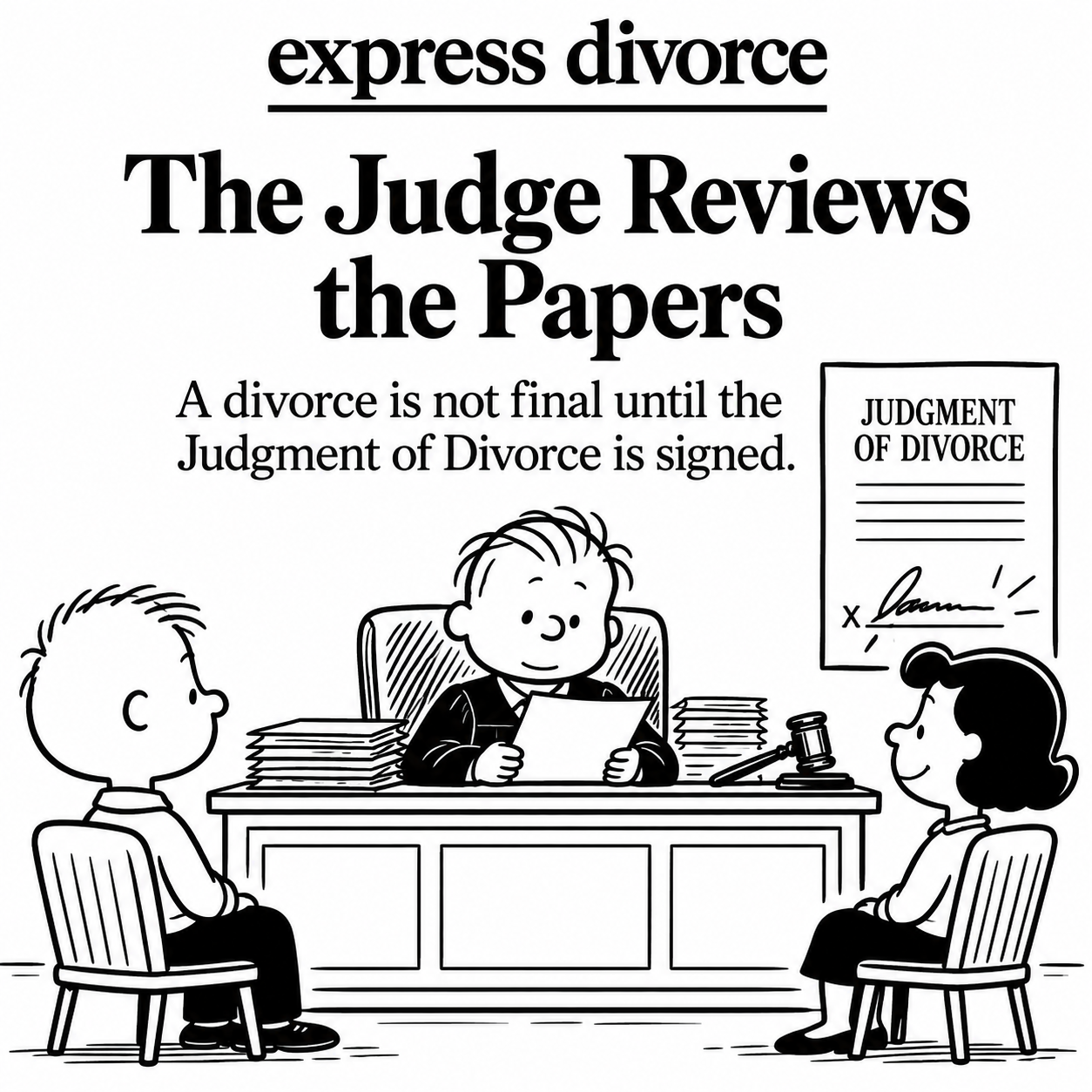
The judge reviews the papers and determines whether the legal requirements for the divorce have been satisfied.
A divorce is not final until the judge signs the Judgment of Divorce.
For a no-fault divorce under DRL § 170(7), one party must swear that the marriage has been irretrievably broken for at least six months, and the required economic and parenting issues must be resolved by agreement or court determination before judgment can be entered.
How Should Agreements Be Documented Before Filing?
Do not rely solely on informal conversations.
The original Q&A emphasized reaching agreement, being transparent, and documenting decisions before generating the court paperwork.
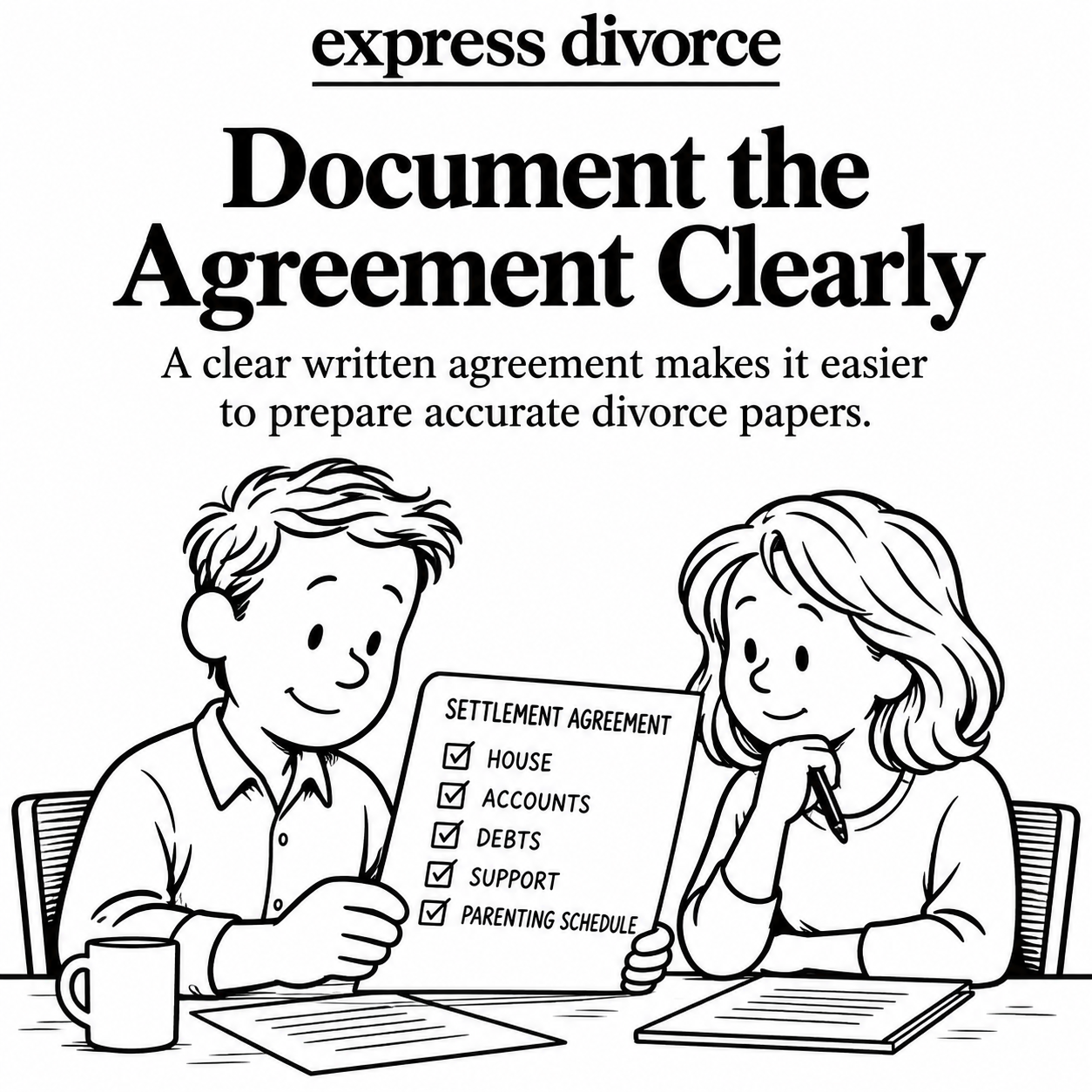
For a New York divorce, the agreement may need to address issues such as:
real estate;
division of marital assets;
retirement accounts;
debts;
maintenance;
custody and decision-making;
parenting time;
child support; and
child-related expenses.
The clearer the agreement, the easier it is to prepare accurate divorce papers.
Choosing the Right Level of Support
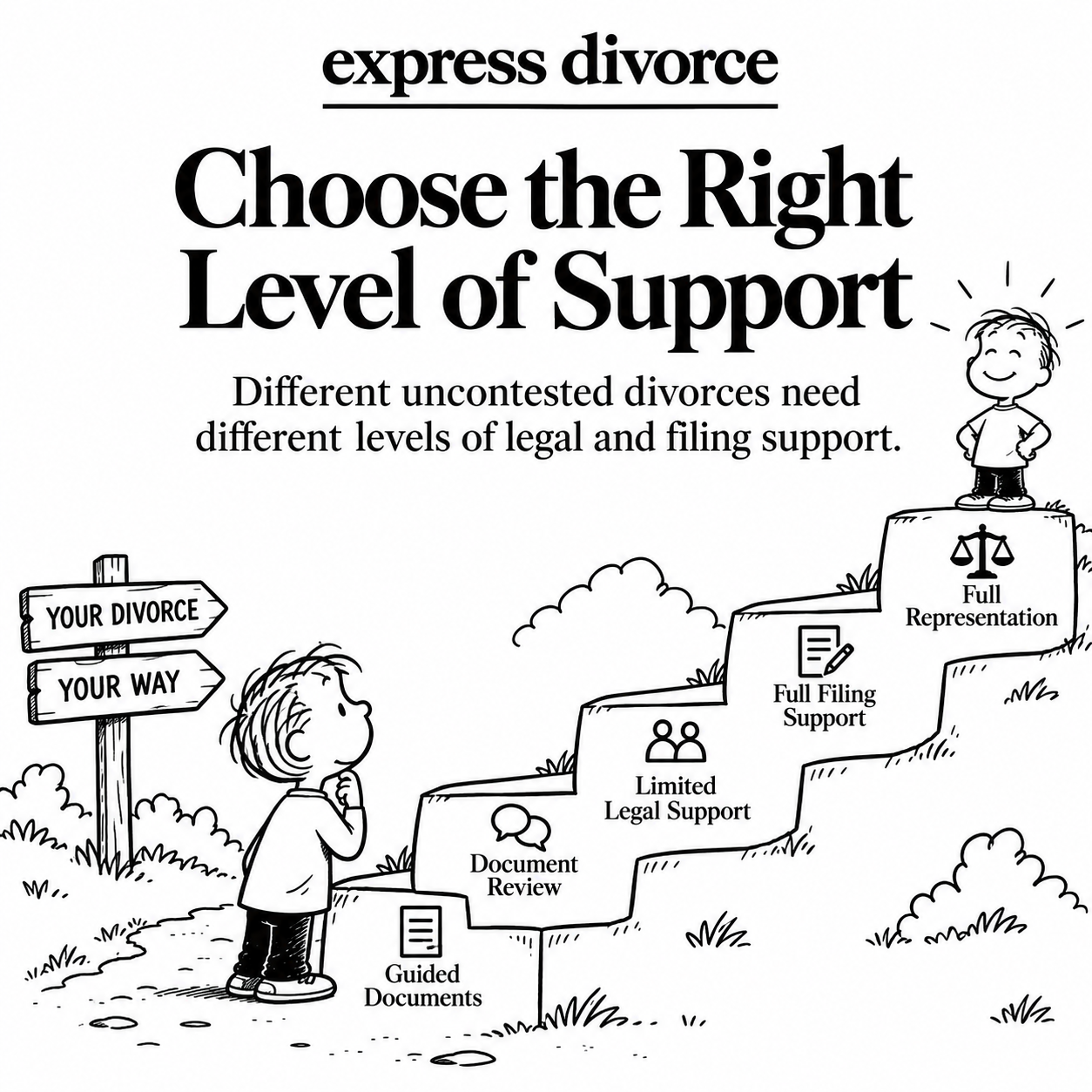
Not every uncontested divorce needs the same amount of professional involvement.
For qualifying New York cases, Express Divorce offers several levels of support:
Express Divorce — $799
Guided divorce documents and filing instructions.
Express Divorce Plus — $1,999
Document preparation, dedicated paralegal support, filing assistance, signature coordination, and case tracking.
Attorney Review — $2,999
Attorney review for qualifying uncontested cases without minor children.
Family Package — $4,999
Attorney-supported review for qualifying uncontested divorces involving children.
Premium Flat Fee Divorce — $6,999–$7,999
Full attorney representation for a qualifying uncontested divorce.
Court filing fees, process service, third-party expenses, contested proceedings, and work outside the selected package may be additional.
Final Thoughts
The New York divorce process becomes easier to understand when it is broken into stages.
First determine whether the case is truly uncontested. Confirm jurisdiction and grounds. Gather the financial and family information you need. Resolve the issues that remain. Document the agreement carefully. Then prepare and file the correct Supreme Court papers.
If disagreements remain, mediation, negotiation, or attorney assistance may help determine whether the case can still become uncontested.
The original Q&A repeatedly returned to the same practical principle: preparation and agreement can reduce confusion and make the process more manageable.
Ready to Understand Your Next Step?
Answer a few questions about your marriage, the issues you have already resolved, and how much professional support you want.
Express Divorce can help you identify the level of assistance that may fit your New York uncontested divorce.
Get Started